
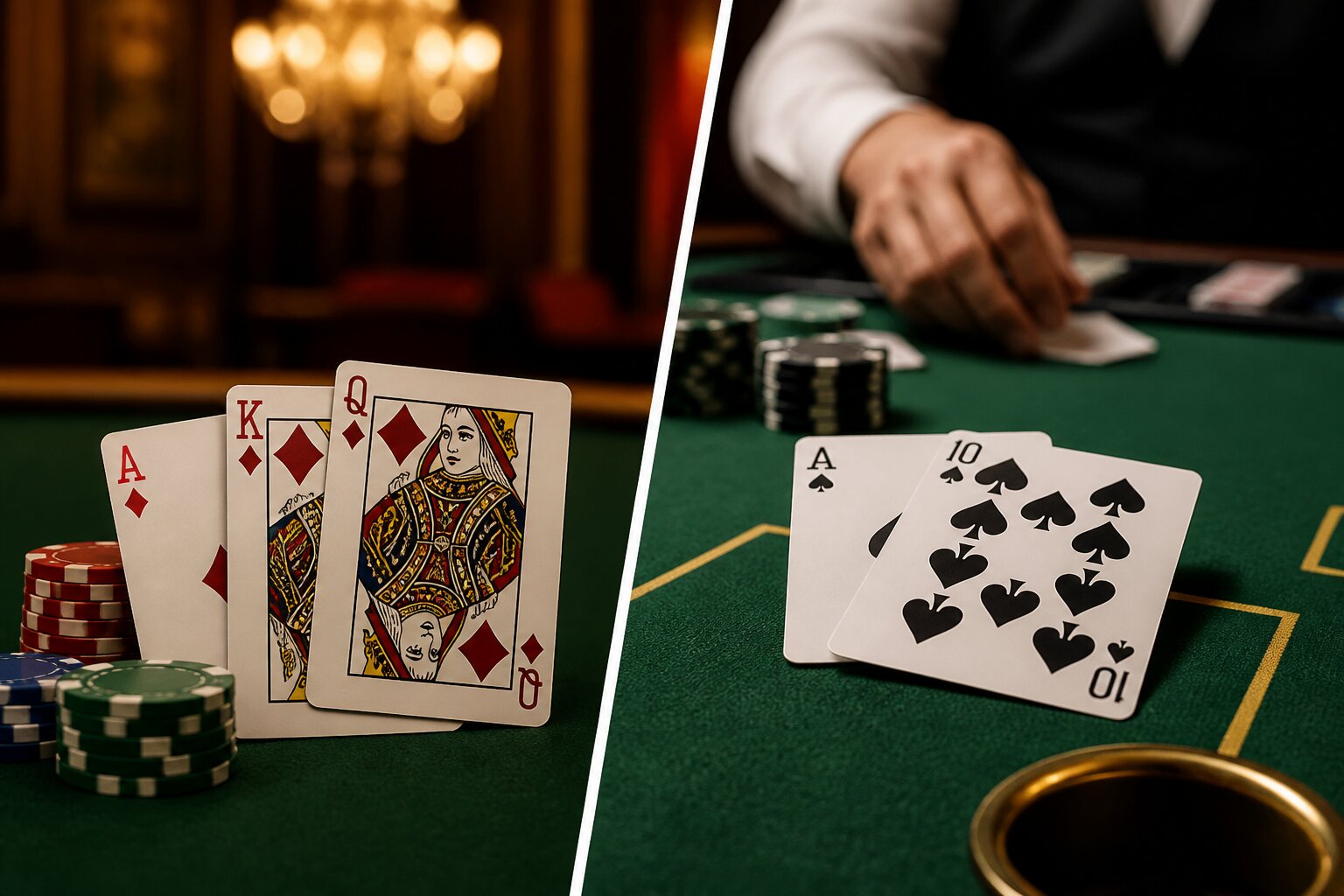
Choosing between 3 Card Poker and Blackjack can feel tricky when you want the best mix of fun, strategy and payouts. Both games are firm favourites at the tables, each with its own pace and appeal.
Before you put your chips down, it helps to know how they work, what to expect from the odds, and which style of play suits you best. Keep reading and you’ll have a clear idea of which table might suit your evening.
What Is 3 Card Poker & How Is It Played?
3 Card Poker is a fast, straightforward card game that’s easy to pick up. Each player and the dealer receive three cards, and the objective is to form a better poker hand than the dealer using only those cards.
The round starts with an ante bet. After the deal, I choose whether to continue by placing a play bet or to fold if my hand looks weak. Winning the main contest usually pays even money, while some casinos offer optional side bets such as Pair Plus, which pay for hands like a pair or better regardless of the dealer’s hand.
There are also bonus payouts for higher-ranking hands—three of a kind or a straight flush can trigger larger returns according to the paytable. The game’s simplicity and rapid rounds make it appealing for players who want a compact, social experience without a lot of complex decision-making.
What Is Blackjack & How Do You Play?
Blackjack is built around a simple goal: make a hand as close to 21 as possible without going over. Both player and dealer start with two cards; number cards count at face value, face cards count as 10 and aces can count as 1 or 11.
After seeing the first two cards, I choose whether to take another card (hit) or keep my total (stand). There are additional options such as doubling down or splitting when the rules allow, which add strategic variety. The dealer follows fixed procedures—typically drawing until they reach at least 17—which removes some uncertainty about how the house will play.
A natural blackjack (an ace plus a ten-value card) typically pays at a higher rate, while ties return the original stake. Although players make choices that influence outcomes, each deal is independent; the focus is on making the best decisions given the information available in each hand.
Before moving on, consider whether you prefer a game of brief choices and quick rounds, or one where each decision can alter the course of a hand.
Comparing 3 Card Poker and Blackjack: Rules, Payouts & House Edge
The two games differ in structure and potential returns. 3 Card Poker centres on a single rapid decision after the deal: play or fold. Blackjack involves a sequence of decisions each hand, giving players more control over how a hand develops.
Payouts reflect those differences. Main wins in both games usually pay 1:1, but Blackjack often rewards a natural with a higher payout. 3 Card Poker adds value through bonus paytables for top hands and optional side bets that can boost short-term payouts.
House edge also varies: Blackjack played with basic strategy commonly has a low edge, often under 2% depending on the specific rules in play. 3 Card Poker’s main wager tends to carry a higher edge, often around 3–4%, while its side bets generally offer even larger house advantages. These percentages show how the house expects to fare over time and are useful when comparing which game gives better long-term value.
Which Game Offers Better Odds: 3 Card Poker or Blackjack?
When weighing odds, the house edge is the clearest measure. Blackjack typically offers the better statistical chance if you apply sound strategy: the house edge can be well below 2% under favourable rules. 3 Card Poker generally presents a higher edge on its main ante/play decision, and its optional bets usually increase the casino’s advantage.
That said, the exact edge depends on rule variations and how consistently you apply strategy in Blackjack. Both games are designed so the casino maintains a mathematical advantage over the long run, so treating play as entertainment rather than a way to make money is the sensible approach.
Is 3 Card Poker Easier to Learn Than Blackjack?
For newcomers, 3 Card Poker tends to be the simpler option. The rules are concise and the decision set is small: fold or play. Learning basic poker hand rankings is the main requirement, and most players feel comfortable after a few hands.
Blackjack has a steeper initial learning curve because of the additional decisions and some rule subtleties, but basic strategy charts reduce complexity and can be learned relatively quickly. Once familiar, those choices become routine and add a layer of engagement for players who like to think about each hand.
Both games are accessible, so the choice often comes down to whether you prefer minimal rules and faster rounds or a game where decision-making plays a larger role.
Player Experience: Table Atmosphere & Game Pace
The feel of a table shapes the session as much as the rules. 3 Card Poker is brisk and sociable, with rounds settling in under a minute in many places. That makes it ideal for players who enjoy quick cycles and a lighter commitment per round.
Blackjack tables can be more focused, with each hand unfolding over a couple of minutes, especially when players deliberate or use strategic options. This can create a concentrated energy that some players prefer.
Whichever table you choose, it’s wise to set a budget and take breaks to keep the session enjoyable and within your plan.
Myths About 3 Card Poker and Blackjack
Misconceptions can skew expectations. One persistent myth is that betting systems or pattern-spotting can overcome the house edge. In truth, no system changes the underlying probabilities of individual deals; the mathematics of each game remains the same regardless of past results.
Another mistaken belief is that a game can be ‘due’ to pay out. Each hand is an independent event, and outcomes don’t accumulate towards some inevitable result. Finally, while skillful play in Blackjack can reduce the house edge, it never creates a guaranteed win—strategic choices simply improve expected outcomes over time.
Keeping these points in mind makes it easier to approach either game with realistic expectations and a clearer sense of how decisions affect the experience.
How to Choose the Right Game for You
Choosing comes down to taste and what you want from the session. If you favour short, straightforward rounds with minimal decision-making, 3 Card Poker is likely to suit you. If you enjoy shaping a hand through repeated choices and learning how small adjustments change the odds, Blackjack will feel more rewarding.
Think about how much skill versus chance you want in play. Blackjack generally rewards study, strategy and attention to the dealer, while 3 Card Poker is faster and relies more on luck. Also consider the pace: some players like a brisk table where hands come quickly, while others prefer a slower game that lets them think over each move.
Consider also the table vibe you prefer and how much attention you want to give to each hand. A busier table can be more social and lively, whereas a quieter table may suit focused play and learning.
Whatever you pick, set a spending plan before you start and take breaks when needed, so the session remains enjoyable and under control. You might find it helpful to follow a few simple rules to keep things sensible:
- Decide on a maximum loss and stick to it.
- Schedule regular breaks to avoid fatigue and poor decisions.
- Play at stakes that match your budget and comfort level.
If you ever feel playing is becoming a problem, seek help promptly and use available tools to limit time and spending. Responsible play helps keep the experience fun and sustainable.
Conclusion: Which Game Should You Play?
Both 3 Card Poker and Blackjack have clear strengths: one offers speed and simplicity, the other offers more strategic choice. Your best pick depends on whether you value quick rounds or prefer the engagement that comes from decision-making. Play within your limits, be mindful of how you feel while playing, and choose the game that keeps your experience enjoyable. If things stop feeling fun or you need advice, support services such as GamCare, BeGambleAware or the National Gambling Helpline are available to help.
**The information provided in this blog is intended for educational purposes and should not be construed as betting advice or a guarantee of success. Always gamble responsibly.