
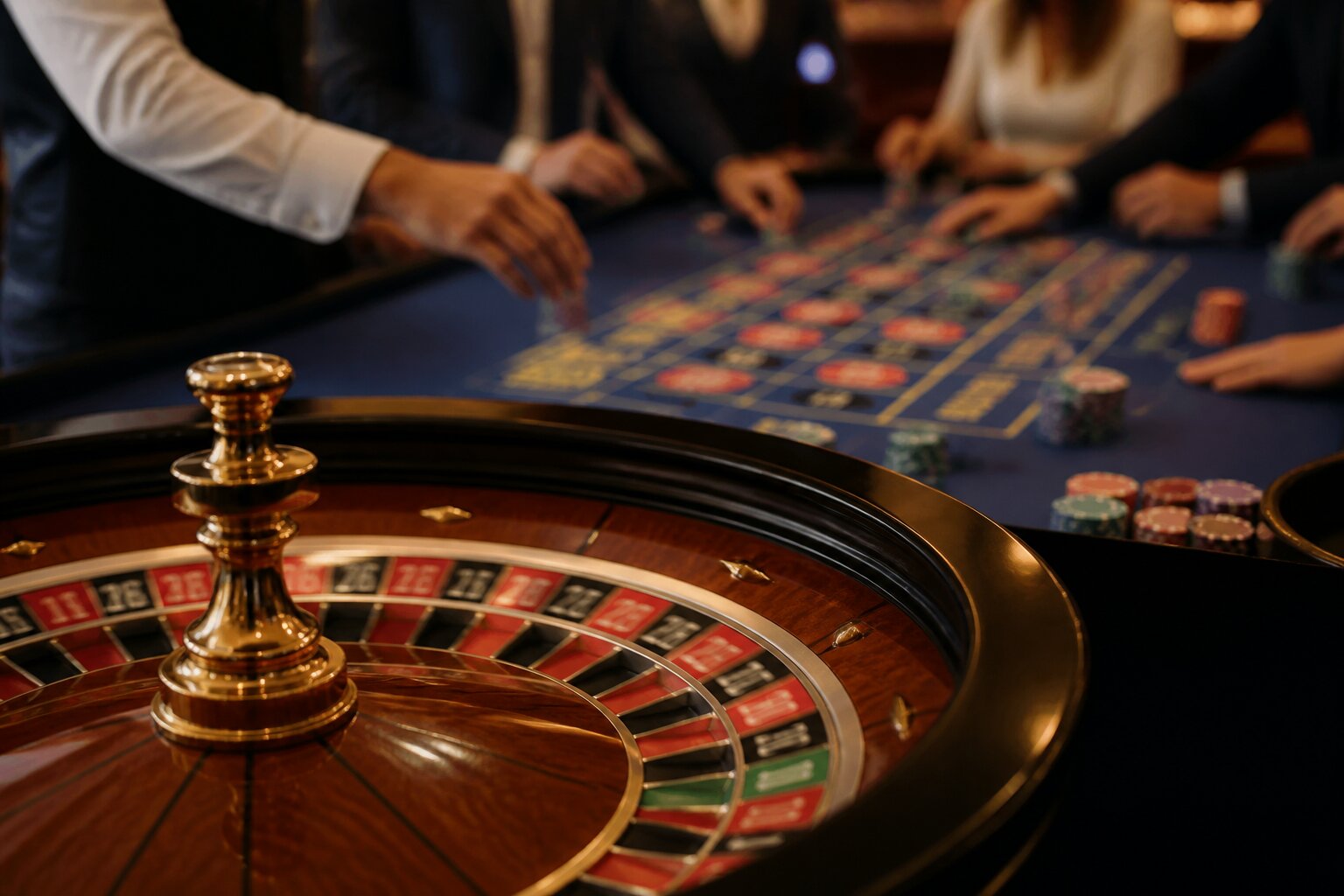
Whether you’re new to the spinning wheel or have spent plenty of evenings at the tables, you’ve probably noticed how quickly patterns seem to appear when you play roulette. You might catch yourself thinking, “Red’s come up three times — black must be next,” or wondering if the table is on a hot streak.
It’s natural to look for trends in a game that hands you one clear result at a time. But should those trends shape your betting decisions? In the sections that follow we’ll examine the patterns players spot, explain the mathematics behind them, and offer a grounded view of what they really mean for someone playing roulette.
What Are Roulette Patterns?
Roulette patterns are simply recurring sequences that players notice while watching successive spins. These can be runs of the same colour, repeated numbers, alternations between even and odd, or clusters of high and low numbers. They stand out because people are wired to look for order in randomness, and the table produces plenty of short-term sequences that catch the eye.
Seeing a pattern does not mean the game has changed or that future outcomes are affected. Patterns are descriptive, not prescriptive: they describe what has happened in a series of spins but do not determine what will happen next. That distinction matters because it separates noticing an interesting sequence from assuming it offers predictive value. Next we’ll look at how individual spins are actually decided, which explains why patterns remain limited to the past.
Understanding the Basics of Roulette Outcomes
Each roulette spin produces a single outcome determined by where the ball lands. Whether the wheel is physical or its online equivalent, systems are designed so that no previous spin influences the next. The wheel’s layout, the presence of green zero pockets and the way outcomes are generated all contribute to established probabilities that stay constant from one spin to the next.
These built-in probabilities create a house edge: a small, fixed advantage that ensures the game operates sustainably over many plays. That edge does not change because a sequence has occurred. With the mechanics and maths in mind, we can better understand why streaks and clusters are possible yet not meaningful for predicting future spins. The next section explores the kinds of patterns players most often notice at the table.
Types of Notable Roulette Patterns
When players track results during a session they most commonly see streaks of colour, alternating sequences, and repeated numbers in short spans. Streaks of red or black, a run of even or odd results, and so-called hot numbers all fit this category. These patterns are the natural output of independent trials with fixed probabilities and are to be expected from time to time.
For example, a sequence of five reds might look surprising, but the same probabilities that produce many other short sequences allow such runs to occur. Likewise, numbers that appear more than once in a brief window do so because each spin is an independent chance to hit any pocket. Recognising these patterns can add interest to play, but they do not confer predictive power. With that in mind, many players ask whether those observations can be turned into a reliable method — the next section considers that question.
Red-Black Streaks in Roulette
Runs of the same colour are the most visible patterns. They can be long enough to grab attention yet still fall within normal statistical behaviour. Players often feel compelled to act on streaks, but the equal underlying odds for red and black on each spin mean that a streak does not change the likelihood of either colour appearing on the next round. This keeps streaks as curiosities rather than indicators.
Alternating Even-Odd Numbers
Alternations between even and odd results give the impression of balance but arise naturally from independent outcomes. Even when spins alternate for several rounds, the next spin is not influenced by that sequence. Alternation can be pleasing to the eye, yet it holds no extra weight in terms of probability.
Number Clusters and Hot Numbers
Short-lived clustering of particular numbers often leads players to label them as “hot.” Statistically, clusters are expected in random sequences, so repeated appearances of the same number over a short stretch do not imply greater future chances. They are part of the same pattern family described earlier: interesting to observe, but not useful for predicting what comes next.
Do Players Really Spot Predictable Patterns?
Players certainly perceive patterns, and that perception can feel compelling. A run of reds, repeated numbers, or alternating outcomes appears meaningful because human brains are adept at detecting regularities. This tendency can lead to the belief that the past somehow influences the future, a reasoning error commonly known as the gambler’s fallacy.
In reality, those perceived regularities are consequences of independent trials with fixed probabilities. Patterns can form, persist briefly, and then dissolve, yet none of that creates a causal link to future spins. Understanding this helps temper the urge to base decisions on apparent trends and shifts the focus back to enjoying the game without treating patterns as a form of guidance. To see why predictive attempts fail, it helps to examine the underlying mechanics and randomness more closely.
Is It Possible to Predict Future Spins?
Predicting the result of a future spin with any reliability is not possible given the way roulette outcomes are produced. Physical wheels and certified random number generators in digital versions are both intended to ensure unpredictability. Because each spin is an independent event governed by the same probabilities, past results provide no actionable information about what will happen next.
People sometimes try to construct systems or bet according to perceived trends, but no method can consistently overcome the game’s statistical framework and house edge. The proper expectation is that randomness limits predictive success; therefore, strategies should not be relied upon to beat the game. With that acceptance in place, the next section explains how probability shapes what players actually observe at the table.
The Role of Probability and Randomness in Roulette
Probability supplies the scaffolding for everything that happens on the roulette table. Each pocket has a fixed chance of being the outcome on any given spin, and those chances do not shift because of earlier results. Randomness produces the varied sequences players see: short runs, alternations and occasional clusters are all consistent with a process that lacks memory.
The green zero pockets alter overall returns and create the house edge, but they do not introduce predictability into individual spins. Recognising randomness helps make sense of why patterns exist without implying they offer a route to success. Having examined the maths behind the game, it’s useful to consider common myths that persist despite this reality.
Common Myths About Predicting Roulette Results
Several persistent myths suggest roulette outcomes can be forecast by spotting the right pattern or using a certain system. Two of the most common are the belief that a number or colour is “due” after a sequence that has excluded it, and the idea that tracking past spins yields a reliable edge. Both misunderstand how independent probabilities operate.
These notions ignore the fact that each spin is separate and carries the same statistical profile as every other. Attempts to exploit perceived patterns typically rest on misapplied logic rather than on an understanding of the game’s mathematics. Realistic expectations grounded in probability prevent chasing false beliefs and keep play aligned with entertainment rather than expectation. With these myths cleared up, the following section contrasts what people observe with the underlying maths.
Pattern Observation vs. Mathematical Reality
Observed patterns and mathematical reality sit side by side at the roulette table. The eye easily records sequences and gives them narrative weight; the maths simply describes the likelihood of those sequences occurring in a system of independent events. Once this distinction is accepted, the role of patterns becomes a matter of experience rather than strategy: they provide interest and conversation but not a competitive advantage.
This perspective helps frame decisions sensibly at the table. Rather than attempting to outwit the probabilities, players can appreciate the variety of outcomes while keeping expectations realistic. The next section addresses how those observations should — and should not — influence behaviour when playing.
Should Roulette Patterns Influence How You Play?
Patterns may shape how a session feels, but they should not drive wagering choices. Noting a streak can add narrative to play, yet using patterns as the basis for betting misunderstands the independence of spins. A measured approach keeps entertainment and financial limits in balance rather than converting curiosity into expectation.
Good practice is to decide on a sensible budget and play within it, treating patterns as part of the game’s texture rather than as clues. That way, observing a sequence remains enjoyable without leading to decisions based on the mistaken idea that past spins alter future odds. With these points in mind, players can conclude their session with a clear sense of what patterns mean and what they do not.
**The information provided in this blog is intended for educational purposes and should not be construed as betting advice or a guarantee of success. Always gamble responsibly.