
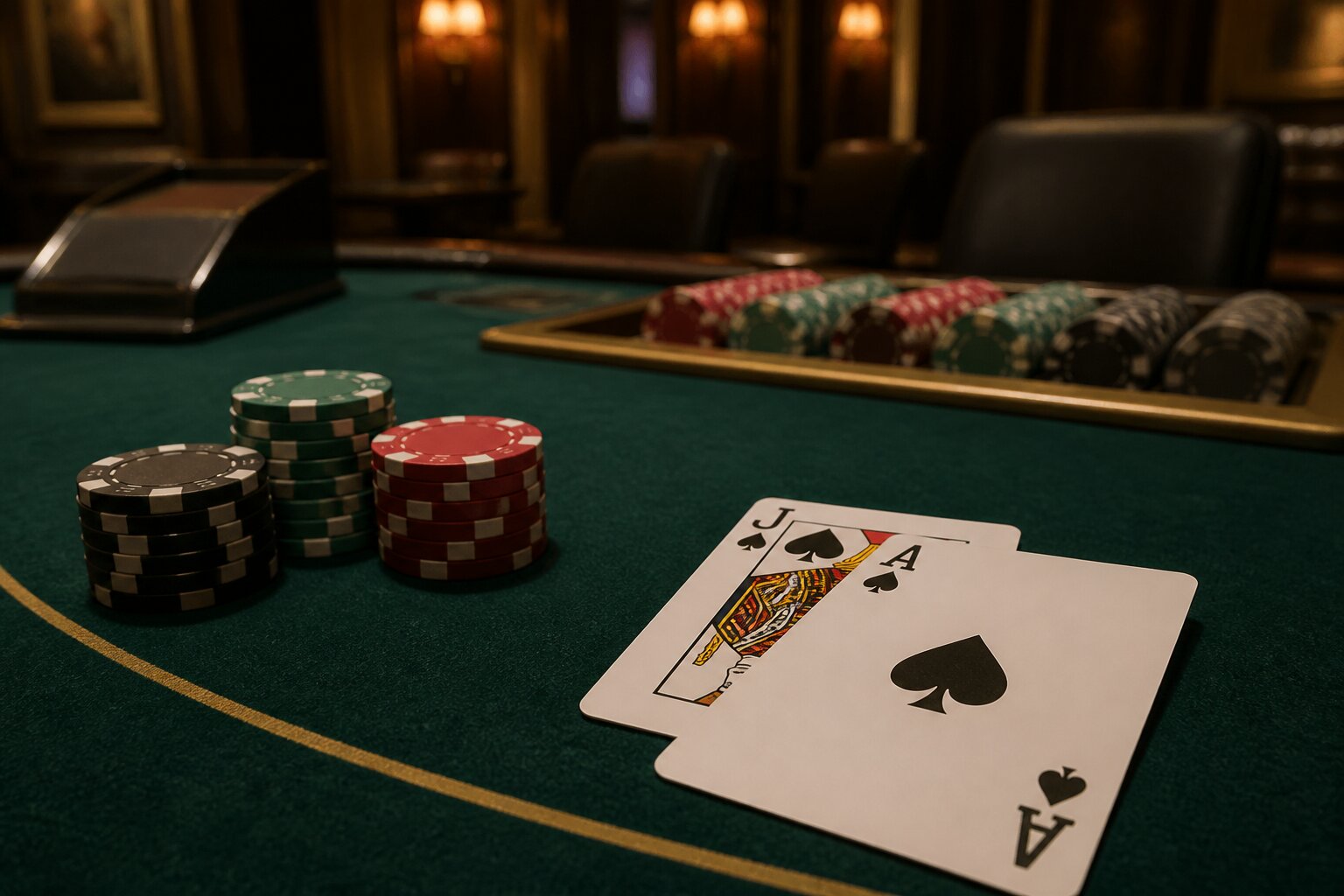
Blackjack is one of the most popular games on the casino floor because it mixes quick decisions with clear rules and the chance for a satisfying win. But if the game often gives good returns for skilled players, how do casinos still turn a profit?
Understanding the house edge — the small statistical advantage the casino holds — sheds light on how games stay profitable without spoiling the fun. Read on and you’ll see how rules, payouts and subtle design choices all add up to a reliable business model for casinos.
What Is the House Edge in Blackjack?
The house edge is the mathematical advantage the casino holds over players across many hands. In blackjack, a well-played standard game typically gives the house an edge of roughly 0.5% to 1%. Practically speaking, that means over a very large number of hands the casino expects to keep about 50p to £1 for every £100 wagered.
That small percentage comes from how the game is structured. A key factor is order of play: players act before the dealer, so a bust by a player results in an immediate loss even if the dealer then busts later. Payout formats also matter — for example, the traditional 3:2 payout for a blackjack rewards the player more than a 6:5 payout, and the latter raises the house edge noticeably.
House edge is a long-run concept. Individual sessions can vary widely, but the statistics converge over time, which is how casinos achieve consistent returns without needing every table to profit every day.
Why Does the Casino Always Have an Advantage?
The casino’s advantage is built into the rules and the roles at the table. Making players act first, followed by a dealer who plays to a fixed set of rules, creates a persistent tilt in the house’s favour.
Dealer play is mechanical: the dealer must hit on certain totals and stand on others. Those rules reduce the dealer’s flexibility but increase the casino’s predictability over many hands. Limitations on player options—such as restricted splits, fewer opportunities to double down, or disallowing late surrender—further nudge expected returns toward the house.
Small rule differences add up. When combined with payout structures and how decks are handled, these elements produce the steady edge casinos need to operate profitably while still offering genuine chances for players to win in the short term.
That balance between structured advantage and player opportunity is what keeps the game appealing while remaining a viable product for venues.
How Do Blackjack Payouts Affect Casino Profits?
Payout ratios are one of the clearest levers casinos use to influence profitability. The classic payout for a blackjack is 3:2: a £10 stake returns £15 in profit for a blackjack. When a casino offers 6:5 for the same outcome, that £10 stake only returns £12, and the reduced reward raises the house edge by over 1% in practice.
These differences may look small on a single hand, but across thousands of rounds they have a marked effect on the casino’s expected income. Payouts for other outcomes, such as insurance or side bets, also tend to favour the house and are priced to be profitable over time.
Before you sit down, it’s worth noting the table’s payout rules. They affect your expected value and help you choose tables that offer the best theoretical return given the same level of play.
What Role Do Rules and Variations Play in the House Edge?
Every rule tweak influences the statistical balance between player and house. Whether dealers hit a soft 17, players are allowed to double after splitting, or surrender is available, each choice shifts the long-term maths.
Standing on soft 17 slightly reduces the house advantage compared with a dealer who must hit that hand. Allowing double after split gives skilled players more ways to capitalise on strong starting hands, lowering the edge. Conversely, banning re-splitting aces or removing surrender options increases the casino’s expected gain.
These variations are compounded by how many decks are used and the specific limits on stakes. Together, they form a package that operators set to match their business needs while keeping play attractive enough to draw customers.
If you’re comparing tables, look beyond the headline game and scan for these small but consequential rules—the differences can be significant over extended play.
Can Changing Deck Numbers Impact Blackjack Odds?
Deck count changes the distribution of cards and therefore alters probabilities. Single-deck games generally offer slightly better odds for players compared with six- or eight-deck games because certain favourable combinations, like player blackjacks, occur a little more frequently when fewer cards are in play.
However, the number of decks is only one factor. When combined with payout structure and rule variations, the overall house edge can shift in either direction. Modern dealing methods—continuous shuffling machines and frequent reshuffles—also blunt any advantage that might arise purely from deck composition.
Testing and certification ensure games deal cards randomly and conform to regulatory standards. Deck number influences the game’s maths, but it’s the interplay with other rules that determines the practical effect on expected returns.
Common Misconceptions About Blackjack and Casino Profits
A range of myths circulates around blackjack, and separating fact from fiction helps set realistic expectations. Methods like card counting can alter expected value under very specific conditions, but casinos use multiple decks, automatic shufflers, and active countermeasures to make such approaches impractical for most players. Successful counting requires deep technical skill, continuous attention, and often game conditions that are uncommon in modern casinos.
The idea of ‘hot’ or ‘cold’ tables suggests streaks carry forward, but each hand is independent; previous outcomes don’t change the probabilities for future deals. Likewise, there’s no strategy or betting system that reliably erases the built-in house edge in the long run.
Knowing these limits clarifies why blackjack is best approached as an engaging game with clear rules rather than a guaranteed source of profit.
How Do Casinos Ensure Blackjack Remains Profitable?
Profitability comes from the careful design and oversight of the game. Casinos set rule combinations, reserve favourable payouts for specific formats, and choose dealing procedures that together create a predictable edge. Regular testing and audits confirm that randomisation and payout logic behave as intended.
Software providers and equipment are subject to independent checks to maintain integrity, and operators monitor play to ensure table rules are observed. The cumulative effect of these controls is a consistent long-term advantage, while still allowing for the variability that makes individual sessions interesting.
Operators also provide features to help players manage their play, such as deposit limits and self-exclusion options. These measures support safer engagement without affecting how the house edge functions.
Conclusion: Understanding the Casino Edge in Blackjack
Knowing how the house edge works lets you approach blackjack with clear expectations and better table choices. Rule sets, payout formats and deck handling all shape the casino’s statistical advantage, but they don’t eliminate the skill and decision-making that make the game engaging.
Key Takeaways
- The casino’s small advantage comes from the game structure—the order of play, payout rates and rule choices.
- Variations such as dealer behaviour on soft 17, splitting and doubling rules, and number of decks change the house edge in measurable ways.
- Widespread myths about guaranteed systems or streaks don’t stand up; outcomes are governed by probability and the established rules of play.
Play Responsibly
Blackjack is designed for entertainment, not as a source of income. Keep stakes within your means and use available account controls if you want to manage how you play. If you ever feel your play is becoming a problem, free support and advice are available from BeGambleAware or the National Gambling Helpline on 0808 8020 133.
Understanding the house edge helps you make clearer decisions at the table, enjoy the game responsibly, and leave the casino with a better sense of how the maths shapes the experience.
**The information provided in this blog is intended for educational purposes and should not be construed as betting advice or a guarantee of success. Always gamble responsibly.