
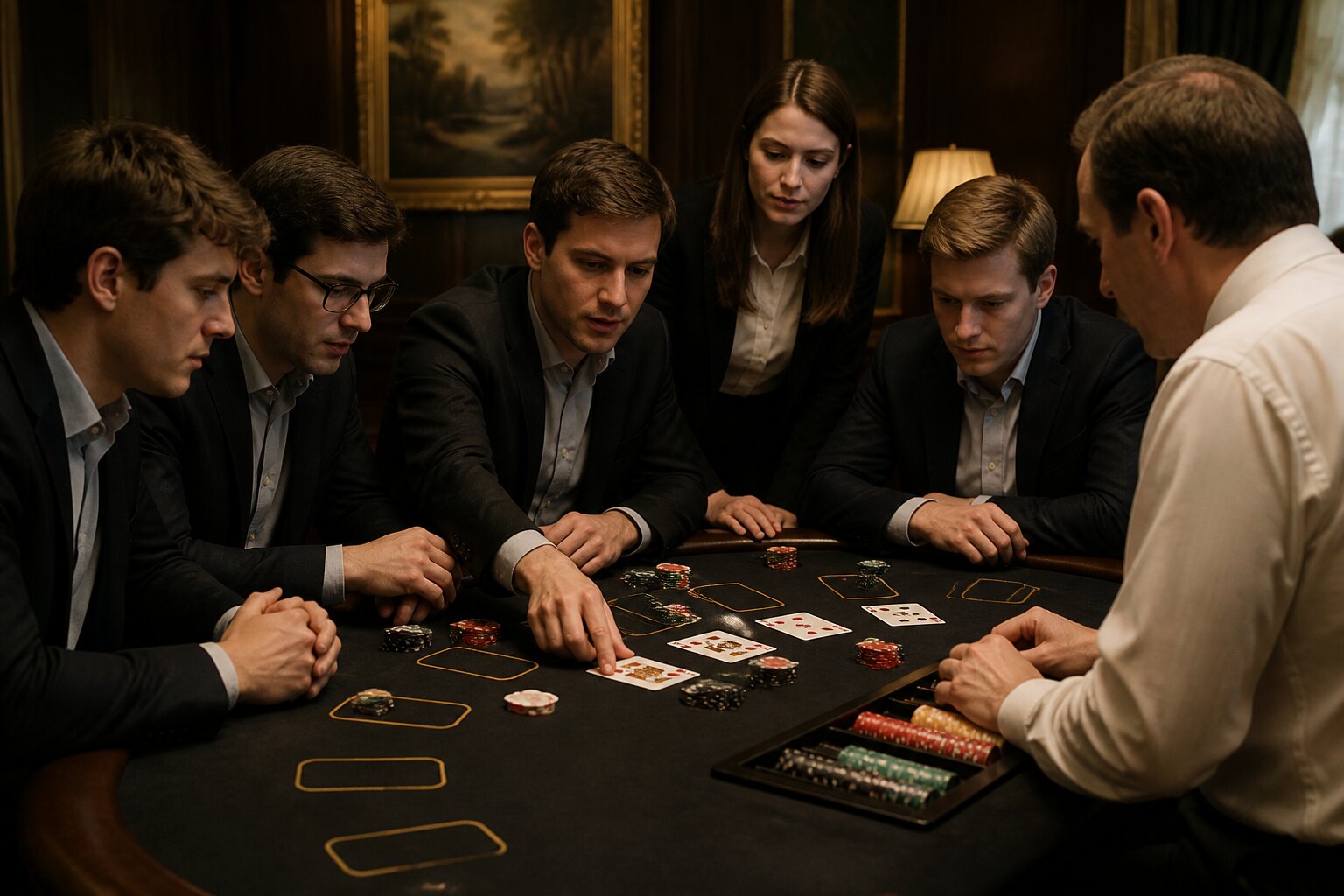
Picture a group of brilliant students outwitting some of the world’s glitziest casinos—not by chance, but with maths and teamwork. The story of the MIT Blackjack Team reads like a thriller: coded signals, late-night flights and fortunes won and lost, all driven by preparation and coordination.
How did these minds manage to gain an edge at the blackjack tables for years? Who were the real people behind the playing cards and disguises, and where did they go afterwards? Read on for a clear, closely researched account of the team’s methods, the myths that grew around them, and the paths members followed after their casino days.
Who Were the Key Members of the MIT Blackjack Team?
The team was never a single, fixed line-up but a succession of players drawn mainly from MIT, with recruits from other universities. They were selected for strong numeracy, calm under pressure and the kind of discipline needed for long practice sessions and coordinated play.
Among the better-known figures were Bill Kaplan, who organised funding and management; John Chang, who helped refine counting techniques and led groups; and J.P. Massar, an early organiser of the operation. Semyon Dukach and Mike Aponte were notable players and leaders who trained others and took prominent roles in games. Many more—spotters, big players and managers—filled specialised roles during different eras.
Members usually played complementary roles rather than acting solo. This division of labour is central to understanding how the group could scale its efforts across multiple casinos without all members having to be experts at every task. The next section describes exactly how those roles fit together and why the team structure mattered for their success.
How Did the MIT Blackjack Team Operate?
Their approach combined rigorous preparation with an organisational model that treated advantage play as a team project. Success relied on disciplined routines, clear communication and careful financial controls rather than improvisation at the tables.
Training emphasised speed and accuracy. Recruits practised card counting until they could maintain counts under distraction, and simulations tested decision‑making in noisy, pressured environments. Training also covered behaviour: how to blend in, vary betting patterns, and avoid attracting attention.
Operationally, the team used a hierarchy. Spotters tracked the count at multiple tables while betting small amounts; when the count turned favourable they signalled a big player to come in and place larger bets. Managers coordinated bankrolls, assigned teams to casinos, and monitored performance. Communication methods were designed to be subtle, so actions at the table appeared ordinary to casino staff.
Money management was formal and central to their model. Winnings and losses were pooled under agreed shares, with detailed records maintained to measure each player’s contribution and to inform future deployments. Security measures for funds and travel were practical—planned transfers, discreet transport and contingency arrangements—to limit exposure to theft or detection.
This disciplined framework allowed them to operate at scale for periods, and the following section breaks down the specific practices and habits that made the system work in day-to-day play.
Recruitment and Training Process
Recruitment focused on candidates who could handle quick mental arithmetic and steady concentration. Prospective members were tested in simulated casino conditions to see how they coped with distractions and irregularities in gameplay. Training blended individual drills with paired exercises that practised signalling and timing, because seamless collaboration at the table depended on predictable, well-rehearsed routines.
Team Structure and Roles
Roles were defined to reduce on-table complexity. Spotters watched several tables and kept the running count with small bets; big players intervened only when the count was advantageous and could place larger wagers; managers oversaw logistics, finances and risk. This separation of tasks let each member focus on a small set of responsibilities, improving accuracy and reducing errors that could attract scrutiny.
Money Handling and Security
Financial discipline was integral. The team pooled capital to spread variance and used formal accounting to allocate winnings fairly. Cash handling, travel and lodging were planned to minimise risk and exposure. While these precautions helped them operate, evolving casino countermeasures later made many of these tactics harder to execute successfully.
These operational details explain how the team translated counting theory into coordinated action at scale. Next, we’ll look at the methods and behaviours that are often described as the team’s “secrets”.
What Secrets Behind Their Success Have Been Revealed?
There are no mysterious shortcuts—what made the MIT team notable was the combination of precise skill, workflow and psychological preparation. Several practical elements stand out.
First, relentless rehearsal produced consistency. Players practised reading shoe composition and making fast, correct betting decisions so that pressure in casinos would not cause mistakes. Second, discreet signalling and a strict code of conduct reduced the chance of detection; players behaved like normal customers until a coordinated opportunity appeared. Third, performance tracking—detailed session logs and statistical checks—let managers identify weaknesses, adjust team assignments and refine training.
A less obvious factor was psychological management. Members learned to control emotions, accept variance and stick to bankroll rules when short-term results diverged from expectations. This mindset reduced the likelihood of impulsive choices that could undermine the system.
These practices are not secrets in the sense of being unknowable, but they do require sustained discipline and a supportive organisational structure. That reality helps set expectations about what the team’s successes did—and did not—represent. The next section addresses whether their results amounted to a decisive, long-term advantage over casinos.
Did the MIT Blackjack Team Really Beat the Casinos?
Yes, the team recorded substantial wins during certain periods. Their coordinated play and disciplined execution created measurable short-term advantages in specific games and conditions, allowing them to extract significant sums before casinos tightened controls.
But those wins had limits. Casinos adapted by changing rules, watching for correlated betting patterns and banning players suspected of advantage play. Human error, variance and the practical constraints of travel and bankroll also capped their sustainable returns. In other words, while the team had profitable stretches, their model depended on favourable conditions that did not persist indefinitely.
This mixed outcome helps explain why the story has a compelling arc: periods of success followed by increasing resistance from casinos. With that in mind, the next section examines how much of the popular narrative matches reality.
What Is Fact and What Is Fiction in Popular Culture?
Popular portrayals amplify drama. Films and novels compress timelines, invent composite characters and stage scenes emphasising tension and spectacle. Real life involved more mundane elements: long practice sessions, careful record keeping and logistical planning. Relationships among members were practical and goal-oriented rather than perpetually cinematic.
A few common myths deserve clarification. The idea of continuous, effortless wins over years is exaggerated; wins came in cycles and required costly preparation. Lavish lifestyles are more often fictional embellishment than typical reality. And while secrecy mattered, daily operations were methodical rather than glamorous.
Understanding these distinctions gives a clearer picture of what advantage play looked like in practice and helps separate the team’s documented techniques from Hollywood storytelling. The next section follows the people themselves after the team’s casino era ended.
Where Are the MIT Blackjack Team Members Now?
Many former members moved into conventional careers where their analytical skills were valuable. Business, finance, tech entrepreneurship and consulting feature heavily among post‑team occupations. For example, Bill Kaplan went into business management and real estate; Mike Aponte moved into education and consultancy; Semyon Dukach pursued entrepreneurship and investment work.
Several members emphasise that the team experience taught transferable skills—project management, data-driven decision making and disciplined teamwork—rather than serving as a lifelong source of income. Others chose to step away from gambling entirely and applied their training to engineering, computing or finance roles.
These varied outcomes underline that the team was a chapter in many professional lives rather than the defining vocation for most participants. The final section explains how their story influenced casino practices and the broader regulatory and safety environment.
How Did the Team’s Legacy Influence the Gambling World?
Their activities prompted casinos to strengthen countermeasures and inspired more sophisticated surveillance and staff training. Changes included closer monitoring of betting patterns, improved customer profiling and tighter rule enforcement. These developments made sustained advantage play more difficult and raised operational costs for anyone attempting similar methods.
Beyond security, the team’s history contributed to stronger emphasis on player protection and regulatory oversight. Operators and authorities introduced tools and rules focused on fairness and consumer safety, such as limits and exclusion options, while regulators tightened standards for transparency and conduct.
The MIT Blackjack Team’s story therefore had a twofold effect: it sharpened casino defenses and encouraged a more regulated, safety-conscious industry. That completes the account of who they were, how they worked, and the legacy they left behind.
**The information provided in this blog is intended for educational purposes and should not be construed as betting advice or a guarantee of success. Always gamble responsibly.