
Ready to up your game at the blackjack table? British blackjack is a classic casino favourite that rewards clear thinking and familiarity with its particular terms and rules.
Whether you’re new to the game or brushing up on details, this guide explains how British blackjack works, the rules you’ll meet at the table, and what the 7 card situation means. Read on to build confidence and enjoy smoother play next time you sit down.
What Is British Blackjack?
British blackjack, commonly called pontoon in the UK, keeps the core aim of traditional blackjack: reach a hand total as close to 21 as possible without exceeding it. What sets this version apart is its vocabulary and a few rule differences that change how rounds feel and how hands are judged.
Terminology shifts are straightforward but important. A natural ace-plus-ten is called a pontoon and outranks all other hands. A five-card hand that doesn’t bust is treated specially and sits just below a pontoon. Players use “twist” and “stick” instead of “hit” and “stand”, which gives the game a distinct rhythm at the table. Also, both of the dealer’s cards stay face down until the end of the round, adding a layer of uncertainty that affects decision-making.
These differences create a familiar game with its own flavour, so the best next step is to see how a round plays out in practice to spot where strategy and table behaviour diverge.
How Do You Play British Blackjack?
A round begins when each player and the dealer receive two cards face down. Players look only at their own hands and decide whether to twist for another card or stick with their total. Number cards count at face value, picture cards are ten, and aces can be one or eleven depending on which is more favourable for the hand.
If the first two cards are a pair, the player may split them into two separate hands, playing each independently. There’s also an option to buy a card: placing an additional stake to receive one more card under specific conditions. After all players have completed their actions, the dealer reveals their cards and follows fixed rules about twisting and sticking.
Because the dealer’s actions are constrained, understanding those dealer rules is useful when planning how far to push a hand. With that in mind, the next section looks in detail at the rules that govern both play and outcomes.
Key Rules of British Blackjack Explained
The primary objective is the same as most blackjack variants: reach 21 or as close as possible without exceeding it. A pontoon (ace plus a ten-value card) beats any other hand. A five-card hand that remains at 21 or below is the next-best result.
Players may twist repeatedly until they either choose to stick or exceed 21, which ends their hand immediately. Splitting allows a player to create two separate hands from matching first cards and continue each independently, while buying a single additional card is permitted when the house rules allow it and an extra wager is placed.
Dealers have a strict remit: they must twist on totals of 16 or less and stick on 17 or more, acting only after players finish. Importantly, ties go to the dealer, which contributes to the house advantage and shapes how players weigh risks during a round. With these rules in mind, knowing the table layout and the practical value of each card helps when planning how to play a given hand.
Typical Table Layout & Card Values in British Blackjack
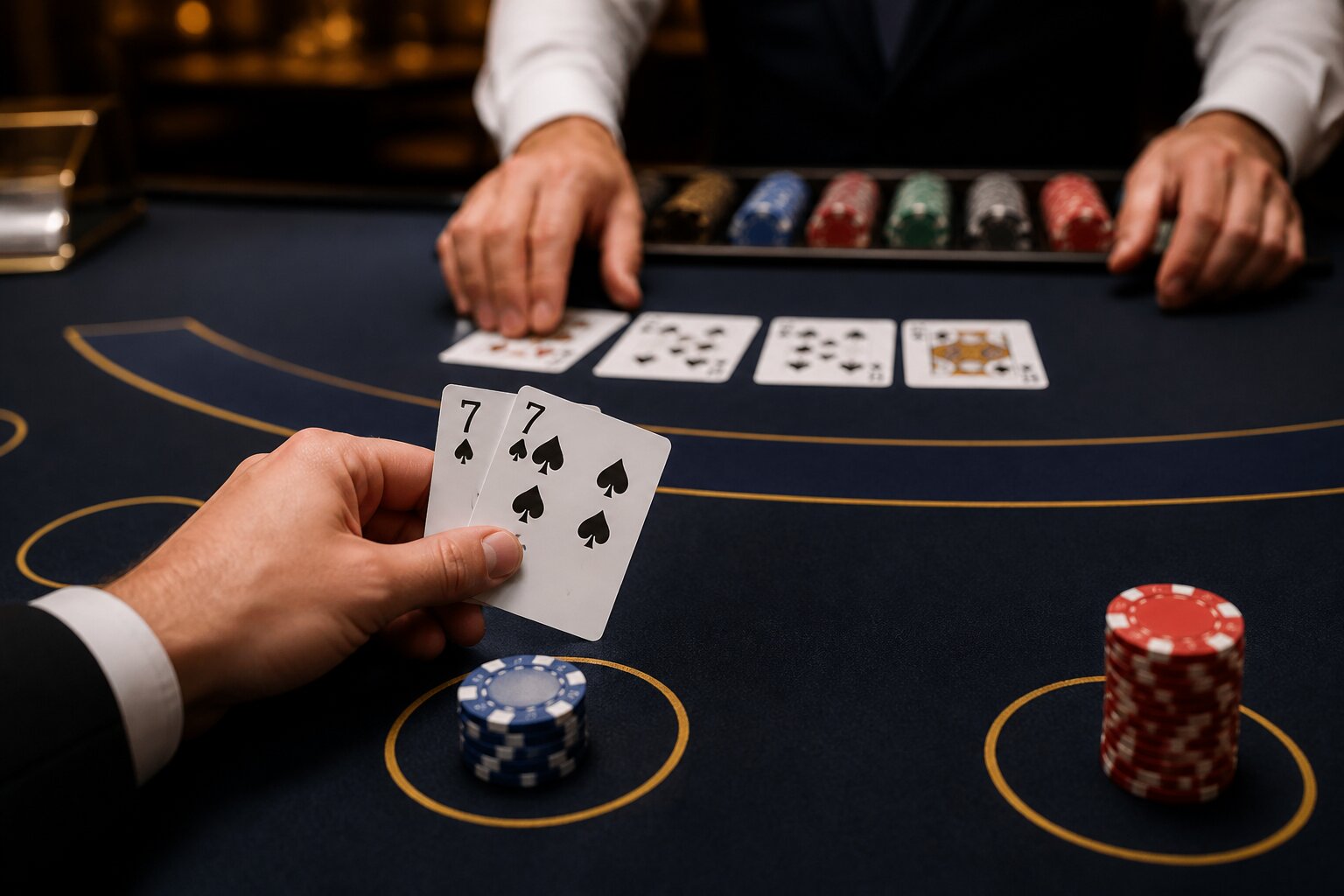
A British blackjack table is usually semicircular, giving the dealer a clear view of up to seven player positions. Each spot has a marked betting area and space for cards; chips are placed within those boundaries to keep play transparent and fair. Busy games often use multiple shuffled decks dealt from a shoe.
Card values mirror conventional blackjack: 2–10 equal their face value, jacks, queens and kings are worth ten, and aces flex between one and eleven. All cards are dealt face down so players see only their own hands until the dealer reveals theirs at the end of the round. This concealed dealer hand changes the strategic landscape compared with games where the dealer has a visible upcard.
Understanding this physical setup and how values are counted prepares a player for the less common rules and special outcomes that follow, such as the 7 card situation.
What Are 7 Card Rules in British Blackjack?
The 7 card scenario describes a player drawing seven cards without the total exceeding 21. When a venue recognises this outcome, it’s treated as a high-ranking result—typically placed below a pontoon and a five-card hand but above ordinary totals. Not every casino applies the 7 card accommodation, so checking the specific house rules matters before committing stake.
Because the situation is rare, its presence can slightly alter how a player judges the risk of taking extra twists in long hands. It does not change the basic arithmetic of card values, but it can be the reason a cautious strategy becomes more appealing when the rule is active. Knowing whether the 7 card outcome is in play helps with informed decisions during a round.
House vs Player: What’s Different in British Blackjack?
The dealer represents the house and acts under set, mandatory rules, whereas players make discretionary choices like twisting, sticking or splitting. Players act first, without knowledge of the dealer’s concealed cards, and the dealer responds only after all hands are resolved.
If a player exceeds 21, their hand is lost immediately; this interaction is central to the house advantage. Additionally, equal totals favour the dealer rather than the player, which influences how aggressively players pursue additional cards. These distinctions explain why player strategy focuses on managing risk within the fixed boundary set by dealer behaviour.
Understanding this relationship clarifies why some hands are played cautiously and why certain table practices exist; next, we’ll separate fact from common misunderstandings that often circulate among players.
Common Myths About British Blackjack
A common misconception is that any strategy can guarantee a win—no single approach overturns the built-in advantage the house holds over time. Another myth is that past outcomes influence future rounds; each deal is independent, so prior hands do not change the odds for subsequent ones.
Not every venue includes the 7 card rule, despite some players assuming it always applies, so confirm local rules before relying on that outcome. It’s also incorrect to assume the dealer has the same freedoms as players: dealers must follow fixed procedures, not personal judgment. Finally, raising bets to chase losses is a risky reaction that tends to worsen results rather than improve them.
Clearing up these points helps set realistic expectations and supports sensible decision-making at the table—alongside proper table manner, which helps everyone enjoy the game.
Essential Etiquette at British Blackjack Tables
Good etiquette keeps the game moving and preserves a pleasant atmosphere. Be courteous to the dealer and other players, wait for your turn, and make decisions clearly. Keep chips and cards within your marked area and avoid touching chips once a hand is in progress; these practices protect the integrity of each round.
When handling pairs, splits or buys, state your intentions audibly and place any additional wagers visibly. If play becomes uncomfortable or problematic at any time, taking a break or stepping away is an appropriate action; venues offer tools and support options for players who wish to set limits or pause play.
Polite behaviour, clear communication and awareness of limits benefit everyone at the table and ensure the session finishes on a positive note.
**The information provided in this blog is intended for educational purposes and should not be construed as betting advice or a guarantee of success. Always gamble responsibly.